
In Mathematics, integers are the collection of whole numbers and negative numbers. Similar to whole numbers, integers also does not include the fractional part. Thus, we can say, integers are numbers that can be positive, negative or zero, but cannot be a fraction. We can perform all the arithmetic operations, like addition, subtraction, multiplication and division, on integers. The examples of integers are, 1, 2, 5,8, -9, -12, etc. The symbol of integers is “Z“. Now, let us discuss the definition of integers, symbol, types, operations on integers, rules and properties associated to integers, how to represent integers on number line.
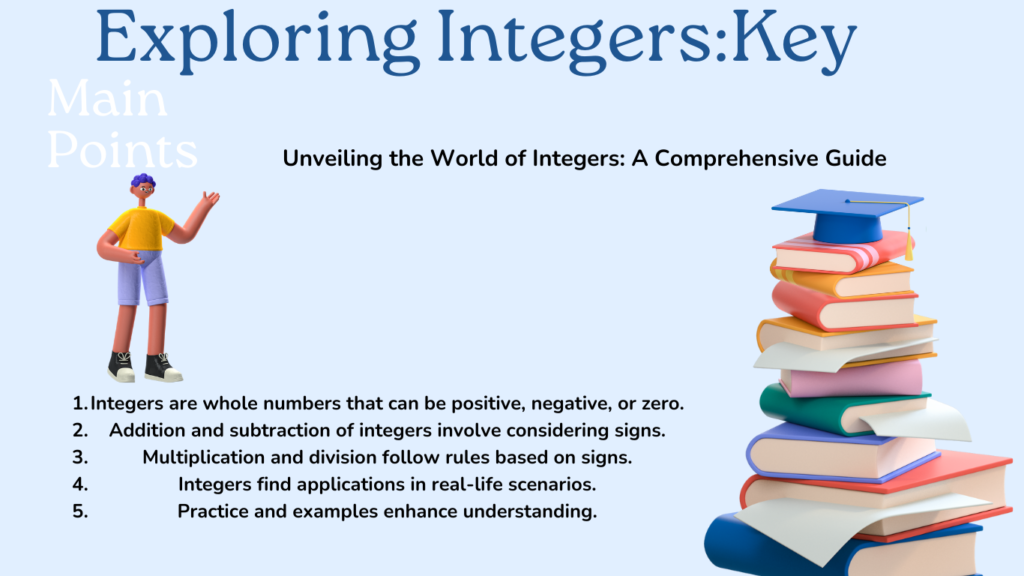
Table of contents
- Definition
- Symbol
- Types of Integers
- Zero
- Positive Integers
- Negative Integers
- Integers on a Number line
- Rules
- Operations on integers
- Properties
- Closure Property
- Commutative Property
- Associative Property
- Distributive Property
- Additive Inverse Property
- Multiplicative Inverse Property
- Identity Property
- Applications
- Solved Examples
- Practice Questions
- FAQs
What are Integers?
The word integer originated from the Latin word “Integer” which means whole or intact. Integers is a special set of numbers comprising zero, positive numbers and negative numbers. Examples of Integers: – 1, -12, 6, 15.
Symbol
The integers are represented by the symbol ‘Z’.
Z= {……-8,-7,-6, -5, -4, -3, -2, -1, 0, 1, 2, 3, 4, 5, 6, 7, 8,……}
Types of Integers Integers come in three types
Zero (0)
Positive Integers (Natural numbers)
Negative Integers (Additive inverse of Natural Numbers)
Zero
Zero is neither a positive nor a negative integer. It is a neutral number i.e. zero has no sign (+ or -).
Positive Integers The positive integers are natural numbers or also called counting numbers. These integers are also sometimes denoted by Z+. The positive integers lie on the right side of 0 on a number line.
Z+ → 1, 2, 3, 4, 5, 6, 7, 8, 9, 10, 11, 12, 13, 14, 15, 16, 17, 18, 19, 20, 21, 22, 23, 24, 25, 26, 27, 28, 29, 30,….
Negative Integers
The negative integers are the negative of natural numbers. They are denoted by Z–. The negative integers lie on the left side of 0 on a number line.
Z– → -1, -2, -3, -4, -5, -6, -7, -8, -9, -10, -11, -12, -13, -14, -15, -16, -17, -18, -19, -20, -21, -22, -23, -24, -25, -26, -27, -28, -29, -30,…..
How to Represent Integers on Number Line?
As we have already discussed the three categories of integers, we can easily represent them on a number line based on positive integers, negative integers, and zero. Zero is the centre of integers on a number line. Positive integers lie on the right side of zero and negative integers lie on the left.
Rules of Integers
Rules defined for integers are:
- The sum of two positive integers is an integer
- The sum of two negative integers is an integer
- The product of two positive integers is an integer
- The product of two negative integers is an integer
- The sum of an integer and its inverse is equal to zero
- The product of an integer and its reciprocal is equal to 1
Arithmetic Operations on Integers
The basic Maths operations performed on integers are:
Addition of integers
Subtraction of integers
Multiplication of integers
Division of integers
Addition of Integers
While adding the two integers with the same sign, add the absolute values, and write down the sum with the sign provided with the numbers.
For example,
(+4) + (+7) = +11
(-6) + (-4) = -10
While adding two integers with different signs, subtract the absolute values, and write down the difference with the sign of the number which has the largest absolute value.
For example,
(-4) + (+2) = -2
(+6) + (-4) = +2.
Subtraction of Integers
While subtracting two integers, change the sign of the second number which is being subtracted, and follow the rules of addition.
For example,
(-7) – (+4) = (-7) + (-4) = -11
(+8) – (+3) = (+8) + (-3) = +5
Multiplication of Integers
While multiplying two integer numbers, the rule is simple.
If both the integers have the same sign, then the result is positive.
If the integers have different signs, then the result is negative.
For example,
(+2) x (+3) = +6
(+3) x (-4) = – 12
Division of Integers
The rule for dividing integers is similar to multiplication.
If both the integers have the same sign, then the result is positive.
If the integers have different signs, then the result is negative.
Similarly
(+6) ÷ (+2) = +3
(-16) ÷ (+4) = -4
Properties of Integers
The major Properties of Integers are:
- Closure Property
- Associative Property
- Commutative Property
- Distributive Property
- Additive Inverse Property
- Multiplicative Inverse Property
- Identity Property
Closure Property
According to the closure property of integers, when two integers are added or multiplied together, it results in an integer only. If a and b are integers, then:
a + b = integer
a x b = integer
Examples:
2 + 5 = 7 (is an integer)
2 x 5 = 10 (is an integer)
Commutative Property
According to the commutative property of integers, if a and b are two integers, then: a + b = b + a
a x b = b x a
Examples:
3 + 8 = 8 + 3 = 11
3 x 8 = 8 x 3 = 24
But for the commutative property is not applicable to subtraction and division of integers.
Associative Property
As per the associative property , if a, b and c are integers, then:
a+(b+c) = (a+b)+c
ax(bxc) = (axb)xc
Examples:
2+(3+4) = (2+3)+4 = 9
2x(3×4) = (2×3)x4 = 24
Similar to commutativity, associativity is applicable for the addition and multiplication of integers only.
Distributive property
According to the distributive property of integers, if a, b and c are integers, then:
a x (b + c) = a x b + a x c
Example: Prove that:
3 x (5 + 1) = 3 x 5 + 3 x 1
LHS = 3 x (5 + 1) = 3 x 6 = 18
RHS = 3 x 5 + 3 x 1 = 15 + 3 = 18
Since, LHS = RHS Hence, proved.
Additive Inverse Property
If a is an integer, then as per the additive inverse property of integers, a + (-a) = 0 Hence, -a is the additive inverse of integer a.
Multiplicatiinverse Property
If a is an integer, then as per the multiplicative inverse property of integers, a x (1/a) = 1 Hence, 1/a is the multiplicative inverse of integer a.
Identity Property of Integers
The identity elements of integers are:
a+0 = a
a x 1 = a
Example: -100,-12,-1, 0, 2, 1000, 989 etc…
As a set, it can be represented as follows: Z= {……-8,-7,-6, -5, -4, -3, -2, -1, 0, 1, 2, 3, 4, 5, 6, 7, 8,……}
Applications of Integers
Integers have various real-life applications. They are used in many fields, including:
- Counting and Quantifying: Integers are used to count objects, people, or events. They are also used to quantify measurements, such as the number of items in a store, the population of a city, or the duration of an event.
- Temperature: Integers are used to represent temperatures on the Celsius or Fahrenheit scale. Positive integers represent above-freezing temperatures, zero represents the freezing point, and negative integers represent below-freezing temperatures.
- Finance and Banking: Integers are used in financial transactions and banking. They represent money gained or lost, account balances, and transaction amounts.
- Sports: Integers are used in sports to represent scores, points, rankings, and statistics. They help track team performance and individual achievements.
- Stock Market: Integers are used to represent stock prices and fluctuations in the stock market. Positive integers indicate price increases, while negative integers indicate price decreases.
- Distance and Position: Integers are used to represent distances and positions. Positive integers may indicate distances traveled in one direction, while negative integers indicate distances traveled in the opposite direction.
- Game Scores: Integers are commonly used to keep track of scores in games, whether it’s a board game, video game, or a sports competition.
QUICK RECAP
Arithmetic Operations on Integers: The basic arithmetic operations performed on integers are addition, subtraction, multiplication, and division.
- Addition of Integers: When adding integers with the same sign, add their absolute values and retain the sign. When adding integers with different signs, subtract their absolute values and use the sign of the number with the larger absolute value.
- Subtraction of Integers: To subtract integers, change the sign of the second number and follow the rules of addition.
- Multiplication of Integers: The product of two integers with the same sign is positive, while the product of two integers with different signs is negative.
- Division of Integers: Similar to multiplication, the division of two integers with the same sign results in a positive quotient, while the division of two integers with different signs yields a negative quotient.
Properties of Integers: Several properties govern the behavior of integers:
- Closure Property: When adding or multiplying two integers, the result is always an integer.
- Commutative Property: The order of addition or multiplication of integers does not affect the result.
- Associative Property: The grouping of integers when adding or multiplying does not affect the result.
- Distributive Property: Multiplication distributes over addition or subtraction of integers.
- Additive Inverse Property: The sum of an integer and its additive inverse (opposite) is equal to zero.
- Multiplicative Inverse Property: The product of an integer and its reciprocal is equal to 1.
- Identity Property: Integers have two identity elements: zero for addition and one for multiplication.
Frequently Asked Questions on Integers
Q1: What are integers? A1: Integers are numbers that include whole numbers and their negative counterparts, as well as zero. They do not include fractions or decimals.
Q2: Can integers be negative? A2: Yes, integers can be negative. Negative integers are represented with a negative sign (-) and are less than zero.
Q3: What are the types of integers? A3: Integers can be categorized into three types:
- Zero (0): It is neither positive nor negative.
- Positive Integers: These are whole numbers greater than zero.
- Negative Integers: These are the additive inverses of positive integers and are represented with a negative sign.
Q4: What are the properties of integers? A4: Some important properties of integers include:
- Closure Property: The sum or product of two integers is always an integer.
- Commutative Property: The order of addition or multiplication does not affect the result.
- Associative Property: The grouping of integers in addition or multiplication does not affect the result.
- Distributive Property: Multiplication distributes over addition/subtraction.
- Additive Inverse Property: The sum of an integer and its additive inverse is zero.
- Multiplicative Inverse Property: The product of an integer and its reciprocal is 1.
- Identity Property: The sum of an integer and zero, or the product of an integer and one, gives the same integer.
These properties help in understanding the behavior of integers under different operations.
If you have any more questions or need further clarification, feel free to ask!

